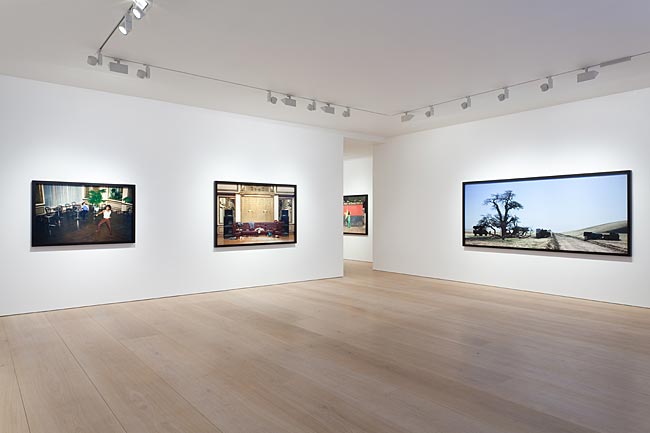
Stan Douglas has created a
series of works that are staged photography with the appearance of documentary
photography. The imagery takes context within the underground culture of Disco
in New York and the liberation of Angola in the 1970’s. Both subjects are
displayed parallel to each other or opposite the other in an exhibition for a
more direct comparison.
What I find to be the most
interesting aspect of the exhibition is the conceptual idea that Douglas is
pursuing. He explores the idea of freedom and how both worlds are parallel in
discovering their newfound boundaries. The meticulous nature of Douglas’ photography
makes the staged works come across as documentary and true, which really
questions the objectivity of photography.
Elements that may have
informed Douglas’ works include his experiences with having lived through this
period of time. Especially whilst the world was at war. The question of
objectivity in photography also becomes interesting when considering that this
period of time was at its peak for propaganda from the Media. It is considered
possible that Douglas created these works as a response to the reception of
truth during this time, possibly to challenge the system of control in the
political hemisphere.
This might relate to the
works of contemporary film, because showing the photographic parallels between
locations gives the viewers a sense of the wider world. This feeling might be
especially apparent as the pieces are situated across the other, which not only
complements the other but also leaves the viewer with a sense of being immersed
into the scenarios. Strangely it also leaves the viewers feeling like they are
stuck in an omniscient plane, observing the doings of those in different
countries. Especially when they’re of two different worlds undergoing similar
situations. I believe that because of this format the viewer is more able to
engage with the works that surround them, which goes against “traditional form”
to think only inside of the frame. It also goes against “traditional forms” by
staging documentary pieces of work, which brings forth a new conceptual layer
regarding objectivity and truth.
What I might take from the
content of this exhibition might be to explore the ideas of freedom and the
parallels between the East and West. Especially considering the parallels
between Germany and the Philippines, because both are typically stereotyped to
be hard working. Also, the conceptual idea of questioning the objectivity of
truth makes me less wary of staged photography. What I might take from the
formal aspects of the work is Douglas’ methods of presenting works parallel to
the other. This would give the pieces as sense of relationships and a
comparison that can be made, especially when I am dealing with concepts that
involve different cultures.


No comments:
Post a Comment