Nastio Moquito, Carlos Noronha
Fei and Richard Perry have created a variety of mixed media works that cover
fine art, photography, sculpture and video. These artists use a sense of irony
to criticize the idea of systems and governing bodies, especially in Mosquito’s
“3 Continents” (2010). In this piece Mosquito uses poetry to dictate the idea
of how politicians can manipulate ideas that are not as useful, into sounding
like they are. In his poetry, Mosquito addresses the issues of faults in the
system such as corruption and how he “bought it” through his election.
In all honesty there weren’t
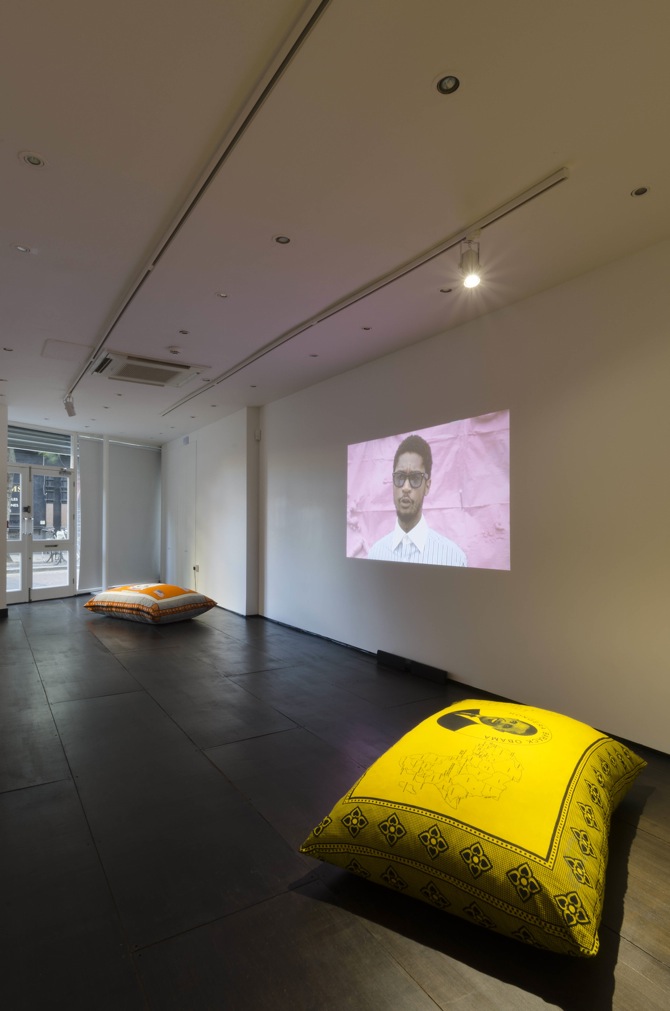
very many other works that were as interesting and significant to me. “3
Continents” grabbed my attention especially for the fact that it was the only
video piece. However what I did find interesting is how pillows of Barack Obama
surrounded it, of which were created by Richard Perry. It felt as though this
arrangement were commenting on how the United State of America is being
governed. The purpose of this video piece’s content is to criticize the way in
which our current system of governing works, so that we may improve on its
flaws instead of blindly believing it to be okay. The fact that Mosquito also
created video pieces for “Europe” shows that Europeans are not free of this
corruption. The fact that Mosquito couldn’t even verbally address “Africa”
shows the apparently obvious nature of the governing corruption.
The audience experiences the
space by entering into a room with a projection of “3 Continents” playing.
Ironically there are two pillows by Richard Perry but no sitting space. This
leaves the viewer feeling impatient, which might reflect on the general opinion
of most politicians. After this space the second room is covered by a bead door
by Richard Perry, and into a room of mixed media works. In this second room the
audience will experience more large scale pillows with Obama’s face, along with
modified photography by Carlos Noronha Feio. This format does not really break
the conventions of traditional form, except for the video piece that is
repeatedly played to mask the silence of the space.
What I might take from the
content of this exhibition is their ability to approach politicians without
getting sued or targeted. This could be because Obama is a major icon so it
would be impossible for him to recognize those who criticize him. As opposed to
my Imelda Marcos piece, not enough people know of her tyranny or seem to
remember who she is outside of the international community. What I find
interesting is how Mosquito never addressed Asia at all. Perhaps this is
something I could explore in my own works. As for the formal aspects of the
work I find it interesting how Mosquito could make his viewers feel so
irritated by not providing them a place to sit. Perhaps I could consider this
when presenting any of my video pieces.


No comments:
Post a Comment