The body of works seen in
Sislej Xhafa’s “assymetric désir” is primarily that of conceptual art. The vast
majority of his pieces are sculptural whilst one (“Woman with Red Skirt”) is
painted. However, despite the slight variation of mediums they all seem to
address the issue of our economic relationship with objects. Xhafa does this by
“challenging our reality,” through works that does not require “shock” to
impact the viewer.
Some of the works that I find
most significant in his exhibition includes “Mother” and “Woman with Red
Skirt.” In the painting “Woman with Red Skirt” the title’s very clear
indication of the color is boldly absent in the painting itself. Instead,
varying shades of grey and green are depicting the form of a Woman in a Red
Skirt. In this piece Xhafa is exploring the idea of consumerist activity and
expectation – showing that the title is not what one might expect.
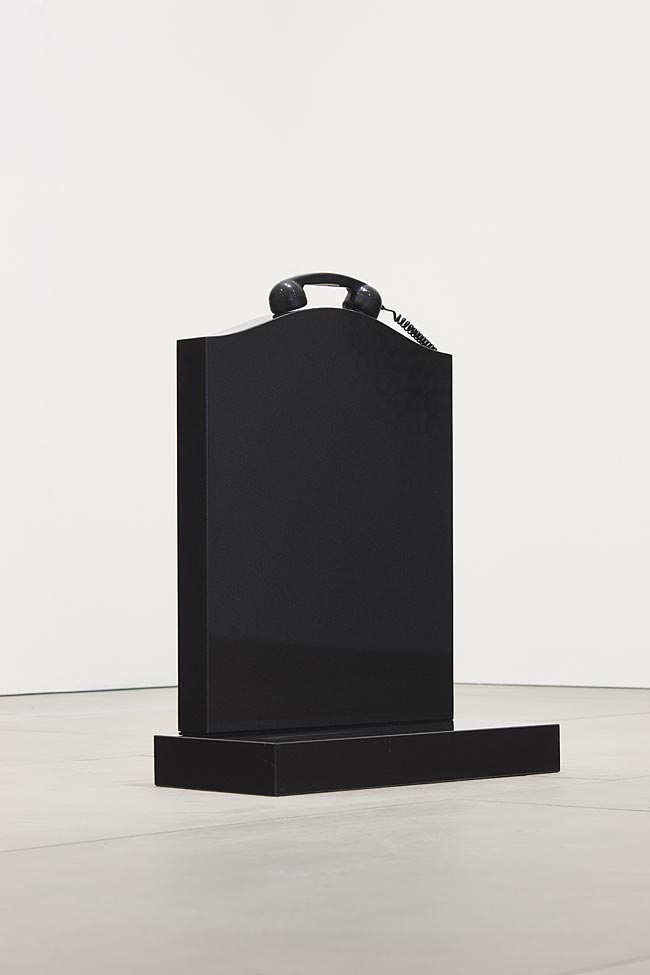
In “Mother,” Xhafa attaches a
telephone receiver to a black, blank, marble tombstone. This challenges our
consumerist desires. Despite our advanced technology, no amount of money or
will power will bring forth the ability for us to speak to communicate with the
dead.
Xhafa’s works correlate to
that of Yoko Ono’s, as they were both commentators of their generation’s
political spheres. Simlarly to Ono, Xhafa also executes his work through
conceptual art. However, Ono is more renowned for being performative. From a
contemporary standpoint Xhafa’s work resembles that of Damien Hirst as a
conceptual artist.
My thoughts on the work is
that Xhafa proves himself to be quite an interesting commentator on the
economic and political status of society, through the medium of conceptual art.
I really appreciate how his works can be decrypted through visual connotations
and not only through shock factor. As one walks through the mostly open space
in the Blain Southern, the wide spaces invite viewers to take their time when
appreciating the works. Unlike traditional forms of art, some of Xhafa’s pieces
are presented as sculptures on the walls. So it retains both the properties of
a painting whilst having the relief and space of a sculpture. This use of wall
space frames Xhafa’s pieces as completed works of art with a “higher meaning”
behind it.
Content that I would explore
in my own work is Xhafa’s uncanny ability to conceptually convey his topics
without the shock factor. This might help my obsessive tendencies to want to
establish a relationship with the audience, as the message I would convey in my
work could be of more importance. The formal aspects I might adapt include
Xhafa’s tendencies to use found objects, as this means it is more recognized by
the wider audiences. However I absolutely adore how he is not bound to a single
medium.



No comments:
Post a Comment