Wednesday, 5 February 2014

Collaboration with I. Maroussi


Second year, BA (Hons) Textiles for Fashion student I. Maroussi approached me asking if we could document her latest creation. The task was to portray her fabric for fashion use, which meant she wanted to portray her fabric as a scarf, skirt and dress. Accepting her proposal, I booked out G28 and started shooting with her model D. Alexandroni. I used my Canon EOS 7D in order to do so, and brought it into CS6 Photoshop for post-processing.

What I found to be the most interesting part of collaborating with Maroussi was her fabric. To create this pattern she had to undergo several phases of dying, screen printing and dissolving velvet with devore. I was fascinated by the layers of labour she had undergo in order to achieve this grungy appearance, and the viewers can literally see every layer of her work on display in the fabric.

Through this collaboration, Maroussi and Alexandroni walked away with portfolio images. Meanwhile I had taught myself how to use the colour curves on CS6 Photoshop in order to give my images a more glossy appearance. It was quite a fun opportunity to expand on my technical skills in photography, especially when Fashion was never my forté. In reflection, what can be noticed is that my stronger images are often portraits. This must be due to my tendency to focus on the viewer's interaction with the gaze, and the vast amounts of practice I have had with portraiture. 

Friday, 31 January 2014

Pop-Up Exhibition: "Traditional Hybrid" with V. Patel

As a part of our coursework, V. Patel and I decided to work together and curate our works in our pop-up exhibition, "Traditional Hybrid." We decided that we should curate our works together because we both cover the themes of cultural hybridity and fusion. Another common trait that we share is that we are both of European-Asian heritage, which makes our works more closely interconnected.

We decided to host the exhibition in a living room space at 17 St. Georges Road. We thought this might have been interesting to play with the idea of the domestic space because of the Asian cultural stereotype that demands for women to stay at home. As half-Asian women we felt that this would be ironic to follow. Contrary to the idea, we decided to keep the European-like interior decor such as the sofas and frilly curtains to contribute towards this cultural confusion.

See below the photos of our set up: 


In total we had approximately ten visitors for our pop-up exhibition. It was during this time Patel and I decided that we definitely wanted to pursue the idea of stereotypes in the role of the housewife in future projects - whether or not it is a positive or negative expectation of women, we are still unsure.

Things I would do in order to prepare better for my next exhibition is find a more convenient location to act as my gallery space. 17 St. Georges Road was definitely more obscure and could have done with a lot more publicity. I will bear this in mind when preparing for our group exhibition. It might be to our benefit to create a Facebook event, pin a few posters up and advertise to the general student body. An exhibition isn't much without viewers.

Monday, 27 January 2014

Discussions with E. Genevier

As a part of this unit's dialogical approaches I decided to approach E. Genevier, a friend of mine who is in her third year of Fine Art. I was told by P. Grant that she would have concepts to the way I would work. If I approached her I would be able to get a more rounded understanding of the concepts that I am exploring.

As a result I arranged a lunch date with Genevier in her studio space, whereby she showed me her works that she was going to graduate with. One of the works includes a massive piece of tapestry where she would continuously embroider a dense stripe across the canvas. This requires a lot of attention and labour, and Genevier even described succumbing into a very meditative state of mind whilst working.

This certainly taught me that there was more to my concepts of materiality and labour. Initially I was slightly upset at how "unoriginal" my choice was to work within that concept. Eventually the realisation came that it wasn't about how "original" my working concept was, because originality as an artist is how I choose to approach that concept through my work.


I started drawing parallels between our work, since I enjoy working with my rice shoes for the same reason. What I enjoy about the concept of labour is the mindlessness that goes behind the act of creating, I enter the same meditative state of mind that Genevier talks about when dealing with her own embroidery.

However, some of the differences in our works is how she seems to be more motivated by the idea of women's communal labour. She describes that when "an entire group of women are sitting down to sew, the labour no longer seems like a chore." As a joke I had suggested that we should work side-by-side to motivate each other.

Steel Butterfly

"Steel Butterfly"

Details of "Steel Butterfly"

The "Steel Butterfly" is one of my current works in progress. It is a portrait of Imelda Marcos that I had digitally printed to be 60 x 75cm. After gaining risk assessed permission from various people within the University, I was then able to tape down the portrait at one of the school's busiest entrances. This was done with the intent of having 3000 pairs of feet walking all over the portrait - a pair of feet for every pair of shoes that Imelda Marcos owns. The ironic thought of having "the people walk all over her" seemed like an interesting catalyst for political dialogue. I thought it would have been interesting to film this process so I rented out a handycam from the University equipment department. 

Creating of "Steel Butterfly" 

The plan commenced as I set up at 8:30AM (30 minutes before the University was due to open) and filmed until 3:00PM. I got approximately 6 hours of footage and 3000 people visiting the piece. However, from those 3000 people only 1500 actually walked all over her portrait. I noticed that in general participants from Asian heritages tended to avoid the image (as a sign of respect), whilst those from older generations had absolutely no problems with walking all over her portrait. Some people from the older generations even danced on her!

When asked why they refused to walk on her portrait, most participants said either "it felt wrong to walk on someone's face" or "her face is just too pretty to ruin." It was at this point I realised that a new theme had arisen from this project - the idea that beauty is power. This discovery approaches some very feminist themes, which could be continued another day. This correlates well towards Marco's biography as she started off as a beauty queen in the Philippines, before eventually becoming the first lady alongside Ferdinand Marcos. The variety of body languages that my participants were creating was very interesting to study, which gave me something to do as I sat there for more than six hours.

At the end of the day the glossy surface of the photograph turns out to be really dusty and scratched. This was precisely the surface I was looking to create from contact with 1500 pairs of feet. Unfortunately not everyone from my 3000 participated by making contact with her portrait, instead I was able to derive a new conclusion from their responses. The six hour long video was then edited to be sped up and last 20 minutes however I found that this video did nothing to either support or take away from the overall concept. If anything it was just an amateur attempt to document the creation of this piece. The framing could have been done better (because I framed according to angles that wouldn't obstruct the path of my participants) so I decided to scrap the video piece all together.

I am quite tempted to not use this piece as one my of my resolved and final works, because of its politically aggressive nature. This is one of my first times creating political art and since Imelda Marcos is still alive and well I am quite paranoid of the negative repercussions that could impact my safety. Due to its creative nature I do want to keep it as a piece of coursework, so I will be submitting it for academic purposes. Following Yoko Ono and Marina Abramovic as my inspirations for performance art, I feel it is my duty as an artist to go ahead, take the risk and present my work as it is. Especially because there is a powerful message that can be derived from the process of performance art, one that makes the piece significant to the time and place in which we currently reside.

If I were to display this in a gallery this piece would have to belong on the floor - the same platform on which it was created. That way the scratched nature of the photograph won't seem out of place if the portrait were to be hung on the wall instead.

Sunday, 19 January 2014

Work in Progress: Stupid Mistakes


The worst part is how this isn't even a mistake I can learn a valuable lesson from. I didn't make any artistic discoveries, experiments or any progress.. This plan was thwarted when I realised I had run out of black acrylic paint. It's a Sunday evening and there is certainly no art shops open at this time. 

Looks like I have to wait until tomorrow. 

As a side note, Patel had discovered that if we used acrylic paint we are able to scratch off any designs that we weren't happy with. This helps us fine-tune our designs to how we want it to appear. The only downside to this is that we can't use the plates when scratching and scrubbing the surfaces are required. I suggested that we could experiment with transparent spray paint as a protective coating at a later stage.  

Work in Progress: Plates with Patel


To follow up on our proposal of working together on a collaborative piece, V. Patel and I have decided to put action into place and painted together on Saturday afternoon for five hours. In this time we managed to paint one plate each. 

What was probably the most tedious task of this project was to think of a continuous design that would still be reminiscent of the henna designs. Patel said that "this just comes naturally after a while," as it is fairly obvious that my plates (left) could do with a lot of practice. This aspect of the project is far more challenging than my rice-shoe project, however, it can be done in less time.

Our group goal is that I will paint three plates whilst she will paint three bowls throughout this entire week. This will hopefully bring us closer towards the dinner table piece we envisioned together. Whether or not we will either destroy the plates or host a dinner party is still under discussion. For now we are just planning to present them on a dinner table for our 4-week project exhibition. 

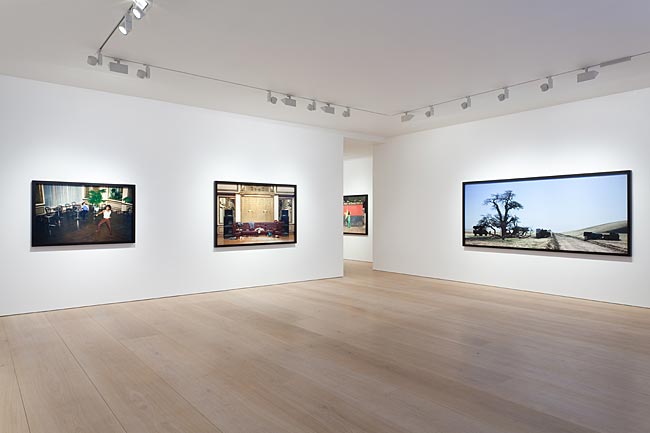
Gallery Review: Stan Douglas’ “Disco Angola” at the Victoria Miro


Stan Douglas has created a series of works that are staged photography with the appearance of documentary photography. The imagery takes context within the underground culture of Disco in New York and the liberation of Angola in the 1970’s. Both subjects are displayed parallel to each other or opposite the other in an exhibition for a more direct comparison.

What I find to be the most interesting aspect of the exhibition is the conceptual idea that Douglas is pursuing. He explores the idea of freedom and how both worlds are parallel in discovering their newfound boundaries. The meticulous nature of Douglas’ photography makes the staged works come across as documentary and true, which really questions the objectivity of photography.

Elements that may have informed Douglas’ works include his experiences with having lived through this period of time. Especially whilst the world was at war. The question of objectivity in photography also becomes interesting when considering that this period of time was at its peak for propaganda from the Media. It is considered possible that Douglas created these works as a response to the reception of truth during this time, possibly to challenge the system of control in the political hemisphere.

This might relate to the works of contemporary film, because showing the photographic parallels between locations gives the viewers a sense of the wider world. This feeling might be especially apparent as the pieces are situated across the other, which not only complements the other but also leaves the viewer with a sense of being immersed into the scenarios. Strangely it also leaves the viewers feeling like they are stuck in an omniscient plane, observing the doings of those in different countries. Especially when they’re of two different worlds undergoing similar situations. I believe that because of this format the viewer is more able to engage with the works that surround them, which goes against “traditional form” to think only inside of the frame. It also goes against “traditional forms” by staging documentary pieces of work, which brings forth a new conceptual layer regarding objectivity and truth.


What I might take from the content of this exhibition might be to explore the ideas of freedom and the parallels between the East and West. Especially considering the parallels between Germany and the Philippines, because both are typically stereotyped to be hard working. Also, the conceptual idea of questioning the objectivity of truth makes me less wary of staged photography. What I might take from the formal aspects of the work is Douglas’ methods of presenting works parallel to the other. This would give the pieces as sense of relationships and a comparison that can be made, especially when I am dealing with concepts that involve different cultures.